• C****y 登录了本站
  • C****y 登录了本站
  • C****y 登录了本站
  • C****y 登录了本站
  • C****y 下载了资源 Amazon多国自动设置邮编助手——免去手动设置邮编的琐碎!
  • C****y 登录了本站
  • t**t 登录了本站
  • C****y 登录了本站
  • 签到打卡,获得0.01发财币奖励
  • 加入了本站

2018年美国对华301关税清单及影响分析-205页

本文档为USTR官方原始文件,包含未公开的税号级影响分析

2018年美国对华301关税完整清单及应对策略,含6031个HTSUS税号影响分析

2018年美国对华301关税清单及影响分析-文章封面图

目录:

1. 背景与概述
1.1301调查背景1
1.2初始关税行动4
1.3中国反制措施5
2. 拟议补充行动
2.12000亿美元商品清单6
2.2关税调整机制7
3. 受影响产品清单
3.1农产品类目11
3.2水产品类目12
3.3工业品类目14
4. 公众评议程序
4.1听证会安排8
4.2意见提交指南9
5. 附录
5.1HTSUS税号对照表11

简介:
2018年美国对华301关税清单及影响分析-文章简介图

本文件详细记录了2018年美国贸易代表办公室(USTR)根据《1974年贸易法》第301条款对中国实施的关税行动。核心内容包括:

1. 三阶段关税措施:初始340亿美元商品清单(2018年7月6日生效)、拟议160亿美元补充清单,以及最新提出的2000亿美元商品10%关税方案(详见文档P6-7)。

2. 完整税号清单:涵盖6031个HTSUS子目,涉及农产品(如冻猪肉0203.29.40)、水产品(活鲑鱼0301.93.02)等关键类目(完整清单见文档P11-14)。

3. 动态影响分析:文件揭示中国反制措施与美国追加关税的博弈逻辑,包含贸易价值测算(2000亿美元占2017年对美出口40%)及产业损害评估框架(详见文档P7)。

跨境电商卖家需特别注意:
– 清单中30%产品涉及常见跨境商品(文档P12显示水产品类目密集)
– 关税传导机制对FBA头程成本的直接影响(文档P7提及FTZ特殊处理规则)

推荐理由:

当前中美贸易政策仍存变数,本文件提供三大核心价值:
1. 历史对照:帮助预判未来关税政策走向
2. 选品避险:识别高关税风险类目(如文档P12揭示的水产品敏感税号)
3. 供应链优化:通过税号级数据调整采购策略

特别适合:
– 涉及美国市场的亚马逊/Walmart卖家
– 水产、农产品等敏感类目经营者
– 需要合规申报的物流服务商
2018年美国对华301关税清单及影响分析-文章场景图

关税红黑榜:

高危类目预警:文档P12显示0302.72.11(冻鲶鱼)、0303.24.00(冻猫鱼)等水产品税号被集中列入清单,相关卖家需立即核查供应链。安全类目如0301.11.00(观赏鱼)未列入清单,可考虑作为替代选品方向。
资源下载
下载价格72 发财币
1. 很多资源无需登录也可直接购买,但是建议大家优选登录后购买,因为这可以永久保留购买记录,后续可重复下载
2. 如遇问题,请在相应资源页面下留言

文件类型:PDF文档
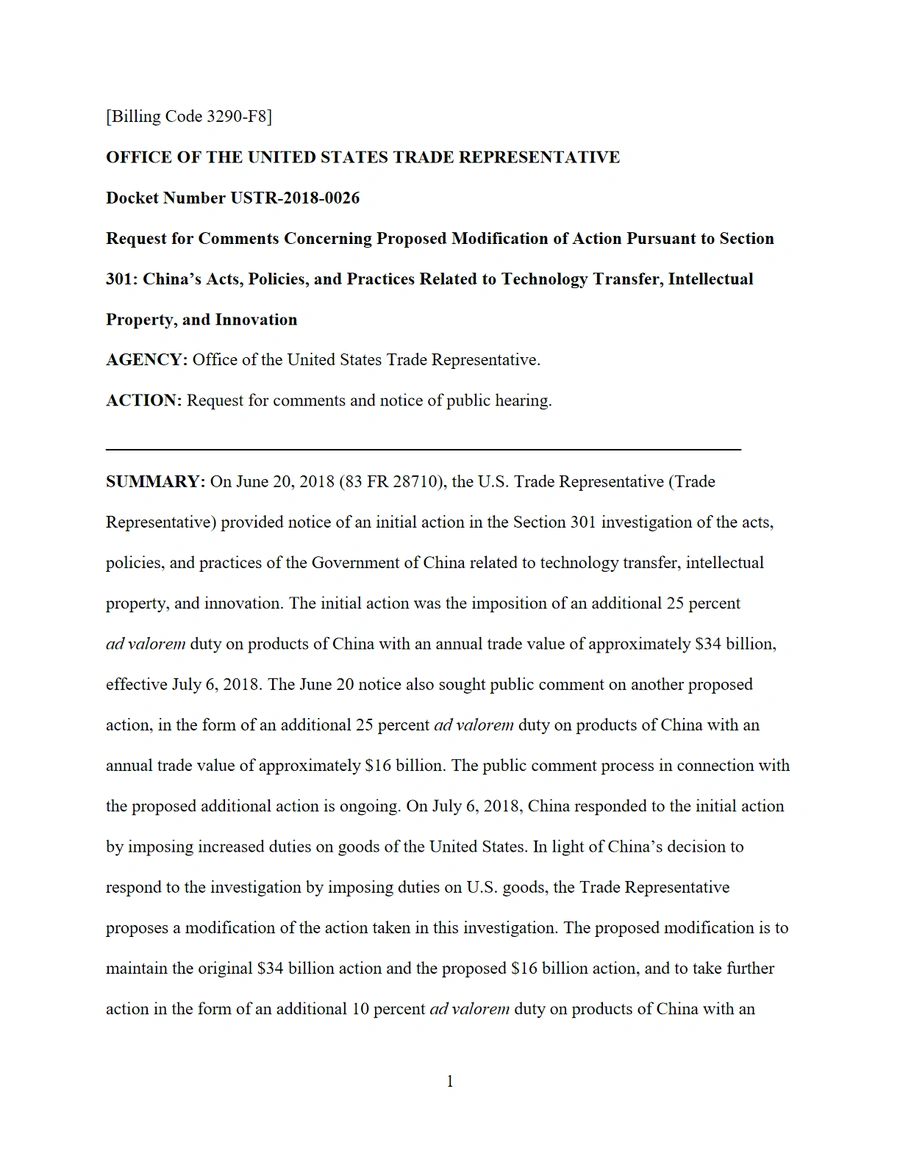
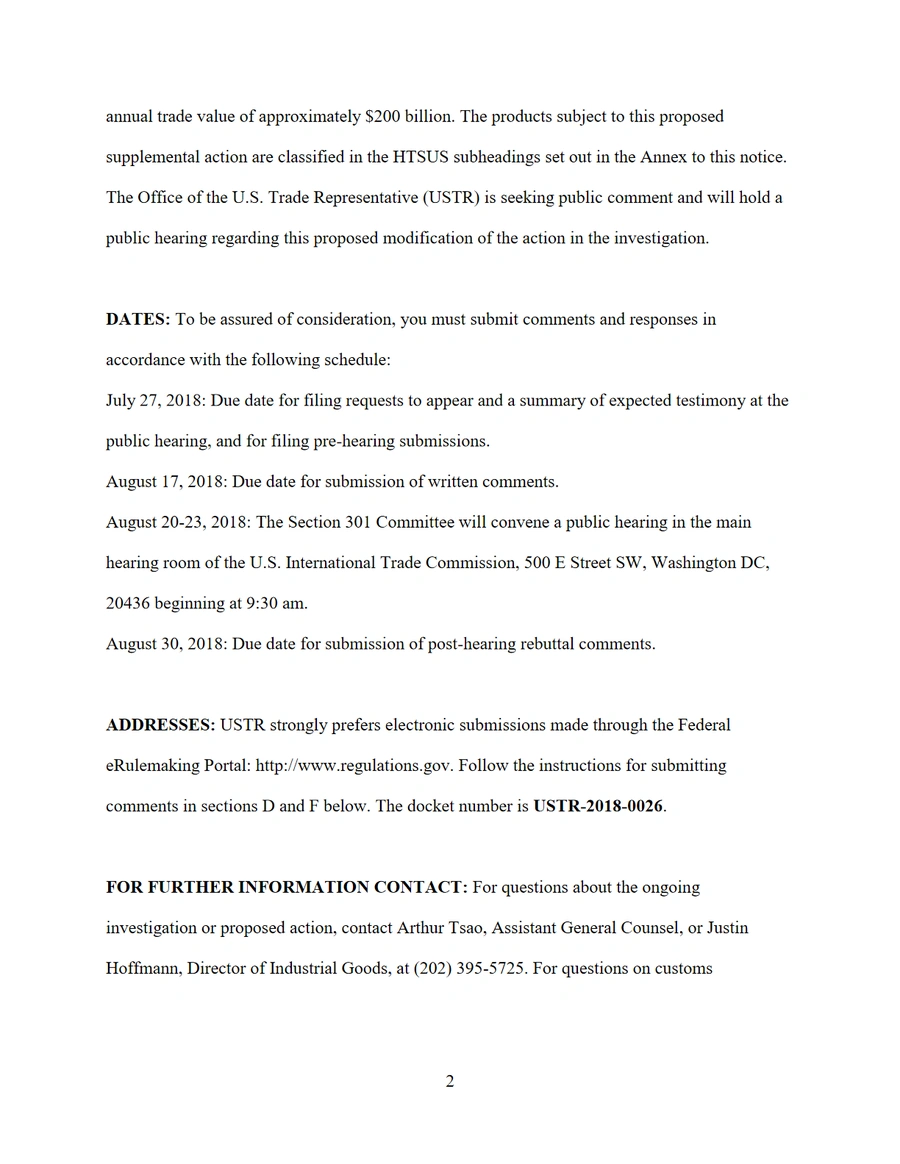
提取的文档内容:PAGE 1 1 [Billing Code 3290-F8] OFFICE OF THE UNITED STATES TRADE REPRESENTATIVE Docket Number USTR-2018-0026 Request for Comments Concerning Proposed Modification of Action Pursuant to Section 301: China’s Acts, Policies, and Practices Related to Technology Transfer, Intellectual Property, and Innovation AGENCY: Office of the United States Trade Representative. ACTION: Request for comments and notice of public hearing. ________________________________________________________________________ SUMMARY: On June 20, 2018 (83 FR 28710), the U.S. Trade Representative (Trade Representative) provided notice of an initial action in the Section 301 investigation of the acts, policies, and practices of the Government of China related to technology transfer, intellectual property, and innovation. The initial action was the imposition of an additional 25 percent ad valorem duty on products of China with an annual trade value of approximately $34 billion, effective July 6, 2018. The June 20 notice also sought public comment on another proposed action, in the form of an additional 25 percent ad valorem duty on products of China with an annual trade value of approximately $16 billion. The public comment process in connection with the proposed additional action is ongoing. On July 6, 2018, China responded to the initial action by imposing increased duties on goods of the United States. In light of China’s decision to respond to the investigation by imposing duties on U.S. goods, the Trade Representative proposes a modification of the action taken in this investigation. The proposed modification is to maintain the original $34 billion action and the proposed $16 billion action, and to take further action in the form of an additional 10 percent ad valorem duty on products of China with an PAGE 2 2 annual trade value of approximately $200 billion. The products subject to this proposed supplemental action are classified in the HTSUS subheadings set out in the Annex to this notice. The Office of the U.S. Trade Representative (USTR) is seeking public comment and will hold a public hearing regarding this proposed modification of the action in the investigation. DATES: To be assured of consideration, you must submit comments and responses in accordance with the following schedule: July 27, 2018: Due date for filing requests to appear and a summary of expected testimony at the public hearing, and for filing pre-hearing submissions. August 17, 2018: Due date for submission of written comments. August 20-23, 2018: The Section 301 Committee will convene a public hearing in the main hearing room of the U.S. International Trade Commission, 500 E Street SW, Washington DC, 20436 beginning at 9:30 am. August 30, 2018: Due date for submission of post-hearing rebuttal comments. ADDRESSES: USTR strongly prefers electronic submissions made through the Federal eRulemaking Portal: http://www.regulations.gov. Follow the instructions for submitting comments in sections D and F below. The docket number is USTR-2018-0026. FOR FURTHER INFORMATION CONTACT: For questions about the ongoing investigation or proposed action, contact Arthur Tsao, Assistant General Counsel, or Justin Hoffmann, Director of Industrial Goods, at (202) 395-5725. For questions on customs PAGE 3 3 classification of products identified in the Annex to this notice, contact Traderemedy@cbp.dhs.gov. SUPPLEMENTARY INFORMATION: A. Background On August 18, 2017, USTR initiated an investigation into certain acts, policies, and practices of the Government of China related to technology transfer, intellectual property, and innovation (82 FR 40213). In a notice published on April 6, 2018 (83 FR 14906), the Trade Representative announced a determination that the acts, policies, and practices of the Government of China covered in the investigation are unreasonable or discriminatory and burden or restrict U.S. commerce. The April 6 notice also invited public comment on a proposed action in the investigation, in the form of an additional 25 percent ad valorem duty on products from China classified in a list of 1,333 tariff subheadings, with an annual trade value of approximately $50 billion. As explained in the notice, the level was appropriate both in light of the estimated harm to the U.S. economy, and to obtain elimination of China's harmful acts, policies, and practices. The public comment process included two opportunities for the submission of written comments, and the opportunity to participate in a public hearing. USTR received thousands of submissions, and held a 3 day public hearing with more than 100 witnesses. The public versions of submissions and a transcript of the hearing are available on www.regulations.gov in docket number USTR-2018-0005. USTR and the interagency Section 301 Committee carefully reviewed the public comments and the testimony from the public hearing. USTR and the Section 301 Committee also PAGE 4 4 carefully reviewed the extent to which the tariff subheadings in the April 6, 2018 notice include products containing industrially significant technology, including technologies and products related to China’s “Made in China 2025” industrial policy program. Based on this review process, the Trade Representative determined to take an initial action in the investigation, and to consider an additional proposed action. The Trade Representative announced the determination on June 15, 2018, and published a notice on June 20, 2018 (83 FR 28710). The Trade Representative narrowed the proposed list in the April 6 notice to 818 tariff subheadings, with an approximate annual trade value of $34 billion. This initial action became effective on July 6, 2018. The additional proposed action is an additional ad valorem duty of 25 percent on products of China classified in 284 tariff subheadings, with an annual trade value of approximately $16 billion. The June 20 notice explained that including these tariff subheadings in the Section 301 action would maintain the effectiveness of a $50 billion trade action. The public comment process in connection with the proposed additional action is ongoing. B. China’s Response to the Action in the Investigation The Government of China has chosen to respond to the initial U.S. action in the investigation by imposing retaliatory tariffs on U.S. goods, instead of addressing U.S. concerns with the unfair practices found in the investigation. On Friday, June 15, 2018, the day that the Trade Representative announced the initial action in the investigation, China issued a statement saying that it was imposing equivalent tariff measures on U.S. goods. On Saturday, June 16, 2018, the Government of China specified that it would impose an additional 25 percent tariff on U.S. goods with a value of $50 billion (State Council Customs PAGE 5 5 Tariff Commission 2018 Public Notice No. 5). China’s announcement sets out two lists. The first list contains 545 tariff subheadings that supposedly corresponds to the initial U.S. $34 billion action, and had an effective date of July 6, 2018. The second list contains 114 tariff subheadings that supposedly corresponds to the additional proposed $16 billion U.S. action, and will be effective on a date to be determined. On Monday, June 18, 2018, the President issued a statement in response to China’s announcement that it was imposing retaliatory tariffs on U.S. goods. See https://www.whitehouse.gov/briefings-statements/statement-president-regarding-trade-china-2/. The statement “directed the United States Trade Representative to identify $200 billion worth of Chinese goods for additional tariffs at a rate of 10 percent. After the legal process is complete, these tariffs will go into effect if China refuses to change its practices, and also if it insists on going forward with the new tariffs that it has recently announced.” On July 6, 2018, the day the initial $34 billion action in the investigation became effective, the Government of China confirmed that it is going forward with the new tariffs it announced on June 16. China also has not changed the acts, policies, and practices identified in the investigation. C. Proposed Supplemental Action Section 301(b) of the Trade Act of 1974, as amended (Trade Act) provides that “the Trade Representative shall take all appropriate and feasible action authorized under [Section 301(c)], subject to the specific direction, if any, of the President regarding any such action . . . to obtain the elimination of [the] act, policy, or practice” covered in the investigation. Section 307 of the Trade Act provides that “The Trade Representative may modify or terminate any action, PAGE 6 6 subject to the specific direction, if any, of the President with respect to such action, that is being taken under [Section 301] if . . . such action is being taken under section 301(b) of this title and is no longer appropriate.” In light of China’s response to the $50 billion action announced in the investigation and its refusal to change its acts, policies, and practices, it has become apparent that U.S. action at this level is not sufficient to obtain the elimination of China’s acts, policies, and practices covered in the investigation. Accordingly, the Trade Representative is proposing to modify the action in this investigation by maintaining the original $34 billion action and the proposed $16 billion action, and by taking a further, supplemental action. The Trade Representative proposes an additional 10 percent ad valorem duty on products of China covered in the attached list of 6,031 tariff subheadings. The attached list has an annual trade value of approximately $200 billion. Modification of the action in this investigation by taking a supplemental $200 billion action is appropriate in light of the statutory goal of obtaining the elimination of the acts, policies, and practices covered in the investigation. China has shown that it will not respond to action at a $50 billion level by addressing U.S. concerns with China’s acts, policies, and practices involving technology transfer, intellectual property, and innovation. Rather, China is responding to action at a $50 billion level by imposing retaliatory duties. Supplemental action at a $200 billion level is in accord with the President’s direction. In addition, action at this level is appropriate in light of the level of China’s announced retaliatory action ($50 billion) and the level of Chinese goods imported into the United States ($505 billion in 2017). China’s retaliatory action covers a substantial percentage of U.S. goods exported to China ($130 billion in 2017). In order to enhance effectiveness, the level of the U.S. supplemental action must cover a substantial percentage of Chinese imports. PAGE 7 7 In developing the list of tariff subheadings included in this proposed supplemental action, trade analysts considered products from across all sectors of the Chinese economy. The tariff subheadings considered by the analysts included subheadings that commenters suggested for inclusion in response to the April 6 notice. The selection process took account of likely impacts on U.S. consumers, and involved the removal of subheadings identified by analysts as likely to cause disruptions to the U.S. economy, as well as tariff lines subject to legal or administrative constraints. To ensure the effectiveness of the action, any merchandise subject to the increased tariffs admitted into a U.S. foreign trade zone on or after the effective date of the increased tariffs, except those eligible for admission under “domestic status” as defined in 19 CFR 146.43, would have to be admitted as “privileged foreign status” as defined in 19 CFR 146.41, and would be subject upon entry for consumption to the additional duty. D. Request for Public Comments In accordance with section 304(b) of the Trade Act (19 U.S.C. 2414(b)), USTR invites comments from interested persons with respect to the proposed supplemental action to be taken in the investigation. To be assured of consideration, you must submit written comments by August 17, 2018, and post-hearing rebuttal comments by August 30, 2018. USTR requests comments with respect to any aspect of the proposed supplemental action, including:  The specific tariff subheadings to be subject to increased duties, including whether the subheadings listed in the Annex should be retained or removed, or whether subheadings not currently on the list should be added. PAGE 8 8  The level of the increase, if any, in the rate of duty.  The appropriate aggregate level of trade to be covered by additional duties. In commenting on the inclusion or removal of particular tariff subheadings listed in the Annex, USTR requests that commenters address specifically whether imposing increased duties on a particular product would be practicable or effective to obtain the elimination of China’s acts, policies, and practices, and whether maintaining or imposing additional duties on a particular product would cause disproportionate economic harm to U.S. interests, including small- or medium-size businesses and consumers. E. Hearing Participation The Section 301 Committee will convene a public hearing in the main hearing room of the U.S. International Trade Commission, 500 E Street SW, Washington DC, 20436, beginning at 9:30 am on August 20, 2018. You must submit requests to appear at the hearing by July 27, 2018. The request to appear must include a summary of testimony, and may be accompanied by a pre-hearing submission. Remarks at the hearing may be no longer than five minutes to allow for possible questions from the Section 301 Committee. All requests to appear at the hearing must be in English and sent electronically via www.regulations.gov. To submit a request to appear at the hearing via www.regulations.gov, enter docket number USTR-2018-0026 on the home page and click “search”. The site will provide a search-results page listing all documents associated with this docket. Find a reference to this notice and click on the link titled “comment now!”. In the “comment” field, include the name, address, email address, and telephone number of the person presenting the testimony. Attach a summary of the proposed testimony, and a pre-hearing submission if provided, by using PAGE 9 9 the “upload file” field. The file name should include both the name of the person who will be presenting testimony and the entity they represent. In addition, please submit a request to appear and a PDF of the summary of proposed testimony by email to 301investigation@ustr.eop.gov. In the subject line of the email, please include the name of the person who will be presenting testimony, followed by “request to appear”. Please also include the name, address, email address, and telephone number of the person presenting testimony in the body of the email message. F. Procedures for Written Submissions All submissions must be in English and sent electronically via www.regulations.gov. To submit comments via www.regulations.gov, enter docket number USTR-2018-0026 on the home page and click “search.” The site will provide a search-results page listing all documents associated with this docket. Find a reference to this notice and click on the link entitled “comment now!” For further information on using the www.regulations.gov website, please consult the resources provided on the website by clicking on “How to Use Regulations.gov” on the bottom of the home page. We will not accept hand-delivered submissions. The www.regulations.gov website allows users to submit comments by filling in a “comment” field or by attaching a document using an “upload file” field. USTR prefers that you submit comments in an attached document. If you attach a document, it is sufficient to type “see attached” in the “comment” field. USTR prefers submissions in Microsoft Word (.doc) or searchable Adobe Acrobat (.pdf). If you use an application other than those two, please indicate the name of the application in the “comment” field. File names should reflect the name of the person or entity submitting the comments. Please do not attach separate cover letters to electronic submissions; rather, include any information that PAGE 10 10 might appear in a cover letter in the comments themselves. Similarly, to the extent possible, please include any exhibits, annexes, or other attachments in the same file as the comment itself, rather than submitting them as separate files. For any comments submitted electronically that contain business confidential information, the file name of the business confidential version should begin with the characters “BC”. Any page containing business confidential information must be clearly marked “BUSINESS CONFIDENTIAL” on the top of that page and the submission should clearly indicate, via brackets, highlighting, or other means, the specific information that is business confidential. If you request business confidential treatment, you must certify in writing that disclosure of the information would endanger trade secrets or profitability, and that the information would not customarily be released to the public. Filers of submissions containing business confidential information also must submit a public version of their comments. The file name of the public version should begin with the character “P”. The “BC” and “P” should be followed by the name of the person or entity submitting the comments or rebuttal comments. If these procedures are not sufficient to protect business confidential information or otherwise protect business interests, please contact the USTR Tech Transfer Section 301 line at (202) 395- 5725 to discuss whether alternative arrangements are possible. USTR will post submissions in the docket for public inspection, except business confidential information. You can view submissions on the https://www.regulations.gov website by entering docket number USTR-2018-0026 in the search field on the home page. Robert E. Lighthizer United States Trade Representative. PAGE 11 11 ANNEX Note: All products that are classified in the 8-digit subheadings of the Harmonized Tariff Schedule of the United States (HTSUS) that are listed in this Annex are covered by the proposed supplemental action. The product descriptions that are contained in this Annex are provided for informational purposes only, and are not intended to delimit in any way the scope of the proposed action. Any questions regarding the scope of particular HTSUS subheadings should be referred to U.S. Customs and Border Protection. In the product descriptions, the abbreviation "nesoi" means "not elsewhere specified or included". HTSUS Subheading Product Description 0203.29.20 Frozen retail cuts of meat of swine, nesoi 0203.29.40 Frozen meat of swine, other than retail cuts, nesoi 0206.10.00 Edible offal of bovine animals, fresh or chilled 0208.10.00 Meat and edible meat offal of rabbits or hares, fresh, chilled or frozen 0208.90.20 Meat and edible offal of deer, fresh, chilled or frozen 0208.90.25 Frog legs, fresh, chilled or frozen 0210.19.00 Meat of swine other than hams, shoulders, bellies (streaky) and cuts thereof, salted, in brine, dried or smoked 0301.11.00 Live ornamental freshwater fish 0301.19.00 Live ornamental fish, other than freshwater 0301.91.00 Live trout 0301.92.00 Live eels 0301.93.02 Live carp 0301.94.01 Other live Fish, Atlantic & Pacific Bluefin Tunas 0301.95.00 Other live Fish, Southern Bluefin Tunas 0301.99.03 Live Tench (Tinca Tinca), sheatfish (Silurus Glanis), bighead carp (Aristichthys Nobilis) and other fish, nesoi 0302.11.00 Trout, fresh or chilled, excluding fillets, other meat portions, livers and r
文件大小:3.1MB
文档页数:205
适用平台:Amazon,Walmart,eBay,Shopify
数据用途:识别高关税风险商品类目
原文链接:https://www.amazon888.com/13906.html,转载请注明出处和链接。
0

评论0

请先

社交账号快速登录

微信扫一扫关注
扫码关注后会自动登录